Purification Series

Product Details

More information

Purification Series

Summary of Fan Selection Instructions of Wucheng Baorui Air Conditioning Equipment Co., Ltd.

Product TypeMixed Flow Fan
ApplicationVentilation
UsageIndustrial/Civil
Air TransferredNon-Flammable
Concentration150Mg/M3
Temperature80
FeaturesWide Application, Duct Ventilation, Pressure Augmentation, Durable Construction, Efficient Airflow

1. Brief Summary

The Fan Selection Instructions of Wucheng Baorui Air Conditioning Equipment Co., Ltd. covers four core categories: ventilation design, operation instructions, special shock absorbers, and electrical boxes. The ventilation design specifies the standard air change rates for different places (e.g., 20 times/h for factory smoke exhaust, 40 times/h for steam bathrooms), fan selection recommendations for corresponding building scenarios (e.g., HTF and HTFC models for smoke exhaust in high-rise buildings), and calculation methods for the number of fans. The operation instructions detail the pre-installation preparations, installation steps, commissioning requirements, maintenance and storage key points of fans, as well as troubleshooting solutions for common mechanical and electrical faults. Meanwhile, it focuses on introducing the overview (withstanding 300°C for 60 minutes of operation and 100°C for 20 hours of operation), classification, working conditions, processing technology, detailed performance parameters (including model number, speed, air volume, etc.), and various external dimension specifications of HTF-type fire-fighting high-temperature smoke exhaust axial fans. It also emphasizes that changes in product specifications and parameters will not be notified separately, and accessory requirements must be specified when placing an order.

Core Framework of Fan Selection Instructions

2. Detailed Summary

I. Core Framework of Fan Selection Instructions

  1. Included Categories: Ventilation design, operation instructions, special shock absorbers, and electrical boxes.
  2. Important Note: Changes in product specifications/parameters/dimensions will not be notified separately.

II. Ventilation Design

  1. Standard Air Change Rates
    • Factories: 20 times/h for smoke exhaust, 12-15 times/h for general ventilation.
    • Special places: 40 times/h for steam bathrooms, 30-10 times/h for bakeries.
    • Civil places: 10 times/h for offices, 10 times/h for meeting rooms.
  2. Fan Selection Recommendations (by Building Scenario)
    • Building fire-fighting smoke exhaust: HTF, HTFC, SWF(A), etc.
    • Civil building ventilation: DBF, HTFC, 4-72, etc.
    • Factory building ventilation: DWT, DZ, T35-11, etc.
  3. Calculation of the Number of Fans
    • By number of people: (Air change volume × Number of people) ÷ Fan air volume = Number of fans.
    • By air change rate: (Indoor volume × Times/h) ÷ Fan air volume = Number of fans.
  4. Order Requirements: Specify the name, model, air volume, etc., and accessory requirements (accessories are not included in regular products).


  5. Fan Series

III. Fan Operation Instructions

  1. Special Precautions
    • Reliable grounding is required; reverse rotation, operation beyond rated current, and phase failure operation are prohibited.
    • Bearings should be oiled at an interval of ≥1000 hours; maintenance during operation is prohibited.
  2. Pre-installation Preparations
    • Check the integrity of packaging, parameters, and accessories.
    • Inspect for deformation/damage and measure insulation resistance (≥0.5MΩ).
    • Prepare materials, tools, and the site.
  3. Installation Steps
    • Familiarize with fan parameters and check the integrity of components.
    • Ducts should be supported independently; adjust levelness and connection fit.
    • Test-run the impeller to check for abnormalities, ensure reliable power connection and grounding, and clean internal debris.
  4. Commissioning Requirements
    • Starting methods: Full-voltage starting (current is 5-7 times the rated current) / Reduced-voltage starting (suitable for power >11kW).
    • Commissioning configuration: At least 2 operators; first check the rotation direction and current, and inspect for abnormalities after 5 minutes of operation.
    • Two-speed fans: Test-run at low speed first, then start high speed after the fan stops.
  5. Maintenance and Storage
    • Keep the environment clean, regularly clean debris; use a dedicated power supply line and prevent phase failure.
    • Stop operation in case of abnormalities (abnormal noise, motor overheating, electric leakage, etc.), and test-run for 5 minutes after maintenance.
    • Bearing lubrication: Add ZL-3 grease every ≥1000 hours (fill 2/3 of the inner and outer rings).
    • Storage: Store in a dry environment, provide rain protection for outdoor storage, and prevent collision.
  6. Troubleshooting
    • Mechanical faults: High bearing temperature (poor lubrication, inclined installation, etc.), vibration (impeller imbalance, etc.).
    • Electrical faults: Failure to start (reverse rotation, small switch capacity, etc.), overcurrent (low voltage, heavy load, etc.).

      HTF-type Fire-fighting High-temperature Smoke Exhaust Axial Fans

IV. HTF-type Fire-fighting High-temperature Smoke Exhaust Axial Fans

  1. Overview
    • Structure: Axial flow type, with high-temperature resistant motor and special cooling system.
    • High-temperature resistance: ≥60 minutes of operation at 300°C, ≥20 hours of operation at 100°C.
    • Application: Dual-purpose for ventilation and smoke exhaust, suitable for high-rise buildings, underground garages, etc.
  2. Classification
    • Installation method: Horizontal type, roof type (W type).
    • Air volume and pressure: Normal pressure type (I, II dual-speed), medium pressure type (III, IV dual-speed), low pressure type (D1, D2).
    • Speed regulation method: Single-speed, dual-speed, frequency conversion (25Hz-50Hz).
  3. Working Conditions: Temperature -20-+60°C (continuous operation), humidity <90%.
  4. Processing Technology
    • Impeller: Made of steel, with hub formed by hydraulic stretching, blades formed by stamping and hydraulic shaping, and static and dynamic balance ≤G5.6 grade.
    • Outer cylinder flange: Formed by integral flanging and spinning.
  5. Performance Parameters: Including model number, speed (r/min), air volume (m³/h), total pressure (Pa), motor model, power (kW), noise (dB(A)), weight (kg) (see the parameter table of each sub-type for details).
  6. External Installation Dimensions: Divided into I/II/III/IV/D1/D2/W types, including dimensions such as D1/D2/D3, L, M1/M2, N1/N2 (see the dimension table of each type for details).


Simple English Summary of Wucheng Baorui Air Conditioning Equipment Co., Ltd.’s Fan Guide

This document is a guide for choosing and using fans from Wucheng Baorui Air Conditioning Equipment Co., Ltd. It mainly includes four parts: ventilation design, operation instructions, special shock absorbers, and electrical boxes.

For ventilation design, it tells the required air change rates for different places (e.g., 20 times per hour for factory smoke exhaust, 40 times per hour for steam bathrooms). It also recommends suitable fan models for different buildings (e.g., HTF and HTFC for high-rise building smoke exhaust) and how to calculate the number of fans needed (based on the number of people or air change rates). When ordering, you must specify details like the fan’s name, model, and whether you need extra parts (regular fans don’t include extra parts).

For fan use, it lists key rules: the fan must be grounded safely; don’t let it run in reverse or with too much current. Bearings need oil every 1,000 hours at least, and you can’t maintain the fan while it’s running. It also explains steps for pre-installation checks (e.g., making sure the fan isn’t damaged), installation (e.g., supporting air ducts properly), and testing (e.g., checking the fan’s rotation direction first). Plus, it gives tips for maintenance (e.g., keeping the fan clean) and storage (e.g., storing it in a dry place). If the fan has problems (like strange noises or failure to start), it offers solutions.

  These fans can work at 300°C for 60 minutes or 100°C for 20 hours, so they’re good for places like high-rise buildings and underground garages. It describes their types (e.g., horizontal, roof-mounted), working conditions (e.g., temperature -20 to +60°C), how they’re made, performance data (e.g., speed, air volume), and sizes.

Finally, note that the company won’t tell you if fan specs or sizes change. You need to specify extra parts when ordering.


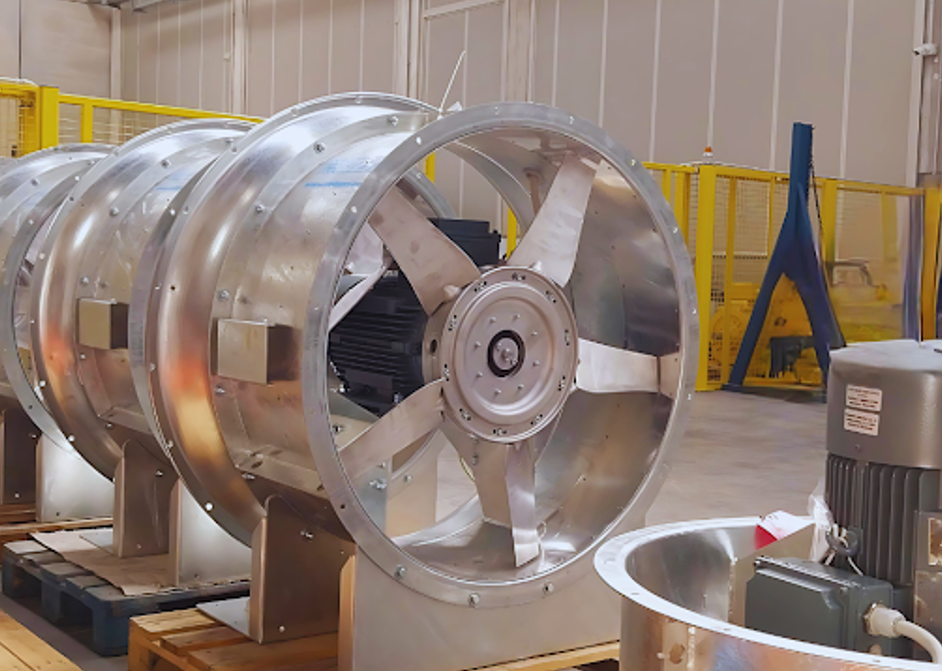
We are engaged in exporting excellent quality SWF Series Mixed Flow Fan to our valuable clients. SWF is widely used for the ventilation of industrial and mining enterprises, hotels, restaurants, stadiums,and civil buildings and especially duct augment pressure ventilation. The air transferred shall not be flammable, corrosive, dust and grain and the concentration shall not exceed 150mg/m3 when the temperature of transporting medium shall not exceed 80a .

Leave Your Message


Write your message here and send it to us

Related PRODUCTS

Leave Your Message